

























































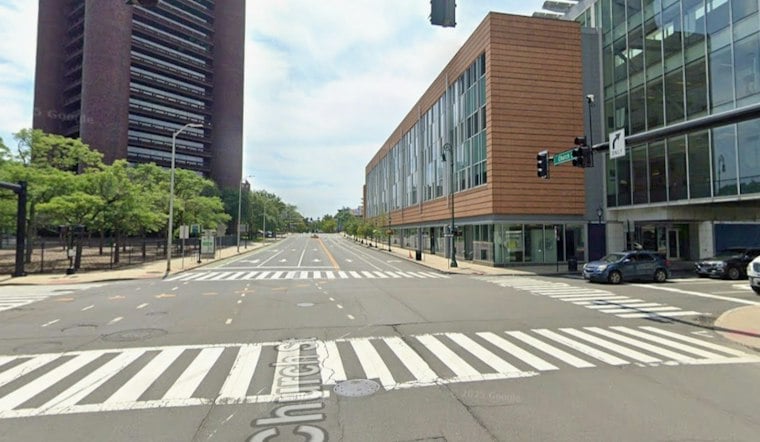
New Haven's City Plan Commission voted unanimously Tuesday to approve design plans for a new quantum research and consumer goods complex at 2 Church Street, clearing the way for a 177,022-square-foot building that will house research facilities for both Unilever and QuantumCT. No members of the public spoke during the project hearing, and commissioners also signed off on soil erosion and site plan reviews needed to move the development forward.
The building, set for construction between 2027 and 2029, will be bounded by Church Street, Martin Luther King Boulevard and South Frontage Road, according to Yale Daily News. It marks the third major development in the city's Downtown Crossing initiative, a decades-long effort to reconnect the Hill neighborhood to downtown New Haven after the area was carved up by the Oak Street Connector highway project.
Consumer goods giant Unilever is investing $270 million in the facility, which Quartz reports represents the company's largest U.S. research-and-development capital expenditure in four decades. That figure includes $50 million in direct capital spending as part of a combined investment exceeding $300 million, per the same outlet. The 2 Church Street site will house roughly 300 employees as Unilever relocates its personal care, beauty and wellbeing research division from a Trumbull campus that had operated since 1972, a move detailed by the Hartford Business Journal, which also reported that Unilever leadership evaluated multiple out-of-state sites before deciding to keep its R&D division in Connecticut.
Inside the Building: Fragrance Labs Meet Quantum Computing
Unilever will occupy about 100,000 square feet across two floors, consolidating consumer insights, fragrance creation, packaging design and product formulation work that will be integrated with AI and quantum computing capabilities, Quartz reports. The facility is expected to serve as the company's primary hub for its beauty and personal care brands.
The building's total footprint runs even larger than its zoning floor area suggests. While the zoning measurement comes in at 177,022 square feet, the Hartford Business Journal's more recent reporting puts the total gross space at 252,892 square feet across four stories on a 1.8-acre city-owned parcel, once a lower level and underground parking structure are factored in. That parcel is slated for purchase by Winstanley Enterprises subsidiary WE 2 Church Street LLC, the outlet reported.
Carter Winstanley, a principal at Winstanley Enterprises, said the 2 Church Street project continues the Downtown Crossing initiative his firm started more than 20 years ago, according to Yale Daily News. The company entered the New Haven commercial real estate market in 1999 with its acquisition of 300 George Street, and later completed 100 College Street in 2015 and 101 College Street in 2023 — both now occupied by biotechnology companies and the Yale School of Medicine. Patch notes that those two earlier projects, like the new complex, were built on land reclaimed from the former Route 34 expressway corridor.
State Dollars Fund Tunnels, Plazas and a New Crosswalk
The project leans heavily on public money to knit the site back into the surrounding street grid. The development relies on $34.7 million in state infrastructure funding to build service tunnels, street and stormwater improvements, and two public plazas connecting 2 Church Street to nearby properties, the Hartford Business Journal reported. New Haven's own plans add a 14,000-square-foot public plaza on the building's west side, which will join the existing plaza at 101 College Street to create a pedestrian connection between Temple Street and Congress Avenue — a link severed when the Oak Street neighborhood was demolished during urban renewal in the 1950s, per Yale Daily News.
Winstanley Enterprises will also install a crosswalk with push-button signals at Congress Avenue and South Frontage Road, a stretch of road that currently has no pedestrian right-of-way, and the new building will feature a ground-floor covered colonnade over the sidewalk along South Frontage Road. New Haven Economic Development Administrator Michael Piscitelli said the city is grateful and inspired to welcome Unilever, according to Yale Daily News.
Laura Brown called the project a significant milestone in efforts to undo urban renewal damage, Yale Daily News reported. The New Haven Redevelopment Agency has documented more than 22,000 individual displacements in the city tied to urban renewal projects between 1954 and 1968, with more than 5,000 of those displacements linked specifically to construction of the Oak Street Connector.
A Grant-Backed Bet on Quantum Technology
The project is part of New Haven's biotechnology innovation cluster and received a $50.5 million innovation grant from the Connecticut Department of Economic and Community Development, Yale Daily News reported. That grant, awarded in September 2025, was the inaugural award issued under the state's Innovation Clusters Program, which targets high-growth technology, life sciences and quantum technology sectors, according to CBIA.
QuantumCT, the research partnership housed in the new building, was established in 2022 as a public-private effort co-led by Yale University and the University of Connecticut to position the state as a regional accelerator for quantum technology. The group is building a 30,000-square-foot headquarters and shared testbed facility in New Haven to give researchers and entrepreneurs specialized lab space and equipment, according to CT Mirror.
Connecticut officials have pledged $121 million to quantum technology initiatives statewide, though $60 million of that is contingent on QuantumCT securing a federal grant through the National Science Foundation's Regional Innovation Engines program, CT Mirror reported. That federal competition could ultimately deliver up to $160 million in additional funding if QuantumCT wins it. While the land sale to Winstanley Enterprises and the building's site plans are now moving forward following the commission's approval, the quantum component of the project remains partially dependent on those broader state and federal grant outcomes.





